Saturday, January 19, 2013

CANON A2300 DIGITAL CAMERA


Canon PowerShot A2300
Design and Features
One of the nicer things about the A2300  is its build quality. The compact camera features a metal body that feels much more solid than the plastic enclosures found on other budget cameras. It is only 2.1 by 3.7 by 0.8 inches (HWD) in size and weighs 4.4 ounces. Our review unit was what Canon calls red—but is in reality more on the magenta side of things—and the camera is also available in blue, black, or silver versions.
The 5x zoom lens covers a 28-140mm (35mm equivalent) focal range, which is pretty nice for a cheap camera. Nicer still is the fact that it has an f/2.8 aperture at the wide end, which should help to make up for some of its high ISO shortcomings. Do not expect to zoom all the way in and capture a lot of light though—at its telephoto extreme the lens closes down to f/6.9, which will require you to be working in good light to get a shutter speed fast enough to get sharp telephoto images. This is one area where the lack of image stabilization really comes into play. 
The physical control layout is identical to that of the A2400 IS . The Zoom Rocker, Power switch, and Shutter release are located on the top of the camera with the rest of the controls on the rear to the right of the LCD. There are buttons to activate Macro mode, toggle between Auto and other shooting modes, and control the Flash. A Record button activates HD video capture, and there is a Help button that brings up an on-screen manual.
The rear LCD is 2.7 inches in size and has a 230k-dot resolution. It isn't as sharp as the ones you'll find on more expensive cameras, but it's noticeably nicer than 3-inch screens of identical resolution. If you opt to shoot in a mode other than Auto, an overlay menu is activated by hitting the center Function button on the rear of the camera. It's quite responsive, and makes it possible to adjust Exposure Compensation, ISO, White Balance, the Drive Mode, and other common shooting settings.
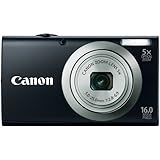
BUY CANON A2300 BLACK At AMAZON CLICK HERE
Performance and Conclusions
When you consider its price, the speed that the Canon A2300 delivers is really quite impressive. It can start up and grab a shot in 2.1 seconds, rattles off a photo every 1.4 seconds in continuous drive mode, and has a short 0.2 second shutter lag. 
The sharpness of the camera's lens is pretty impressive. According to Imatest the A2300 records 1,939 lines per picture height at its widest angle setting. This exceeds the 1,800 lines that denote a sharp image.
    
PHOTO SHOOT WITH CANON A2300

The camera doesn't fare as well in terms of noise control. Its small sensor is packed with 16-megapixels of resolution, and is a CCD—a technology that doesn't do as well at higher ISO settings as CMOS does. Images from the camera are below the 1.5 percent noise threshold at its base ISO setting of 100, increasing slightly to 1.8 percent at ISO 200 and 400, and topping out at 2.8 percent at ISO 1600. The camera also performs some pretty aggressive noise reduction at ISO 800 and 1600—fine detail is almost completely erased from photos at those settings. You should be able to get acceptable, albeit slightly grainy, results by keeping the camera's ISO set to 400 or below and using the flash as necessary. 
The A2300 can record QuickTime video in 720p25 format, which isn't great for fast motion, but does give a rather cinematic feel to the footage as it is close to the frame rate used by most movie cameras. The footage looks ok, but there is evidence of some compression and video compression, even under studio lighting. The camera's lens isn't able to zoom in or out when you're recording video, nor can it refocus once recording is started. Digital zoom is supported, but the quality of the video starts to degrade dramatically the moment that you activate it. The A2300 has a standard mini USB port to connect to a computer and supports SD, SDHC, and SDXC memory cards.

If you're looking for a good camera on a budget, the A2300 would be a good way to go—if it weren't for the A2400 IS. The extra ten dollars you spend on that camera brings image stabilization to the table, which should help you keep the ISO setting a bit lower. If you're on a very strict budget, you can save a little money and opt for  Panasonic Lumix DMC-S3 and features an optically stabilized 4x zoom lens.
Canon PowerShot A2300 IS 16.0 MP Digital Camera with 5x Digital Image Stabilized Zoom 28mm Wide-Angle Lens with 720p HD Video Recording (Black)

RELATED TOPIC:
NIKON D800           Samsung WB150F        Samsung MV800     Canon EOS REBEL T3


Sunday, January 13, 2013

NIKON D800 Camera


Picture Link to Nikon D800
  • *
  • As of February 7, 2012, among interchangeable lens digital SLR cameras employing an image sensor of 35mm film size.

Standard ISO 100 to ISO 6400, range expandable to ISO 50 to 25600 equivalent

The D800/D800E render levels of texture, nuance and detail to your photography that, until now, have been the exclusive domain of the complicated medium-format system. Define every eyelash, every line in tree bark, and every shimmer of light. Savor the exceptional depth in your still images — with the astounding 36.3 effective megapixels, the world's highest*, you can. Enlarge them as big as A1 poster-sized prints (59.4 x 84.1 cm/23.4 x 33.1 in.) at 200 dpi, or crop aggressively to reach the composition you desire, all without sacrificing the detail and tonal range of the original. In order to maintain clean, high-resolution images, 14-bit A/D conversion within the sensor and a high signal-to-noise ratio deliver phenomenal images in a diverse array of situations. The image sensor's incredible potential does not stop with photography, either. For cinematographers ready to put their exceptionally sharp NIKKOR lenses into action, the D800/D800E's 36.3 effective megapixel data is efficiently processed for exquisite 1080p broadcast quality video at 30p.
High-resolution, studio-quality images shouldn't be restricted to the studio. The D800/D800E set a new benchmark for high-resolution D-SLR cameras, with crisp clean images across a wide ISO range. Flexibility like this opens up new imaging opportunities for both still photographers and cinematographers alike during the "magic hour", the time just before dawn or at dusk when available light is often beautiful but scarce. Even at high ISO settings, the camera's intelligent noise reduction systems manage noise without sacrificing fine details, giving the D800/D800E the edge. The difference can even be seen in low-contrast subjects such as hair and grass textures, which are often essential elements of cinema as well as high-resolution portraits and landscape images. High image quality at higher ISOs also means that you can shoot still images handheld more confidently, knowing that fast shutter speeds will reduce blur.


A strategic approach to turn light to your advantage

Combining both high-resolution performance and a wide ISO sensitivity range has finally become a reality. Nikon engineers have developed intelligent new methods to manipulate light transmission to the sensor's photodiodes: from the optical low-pass filter and on-chip gapless micro lenses to the image sensor's internal design, every measure has been taken to maximize and improve light transmission in order to deliver crisp, brilliant images with significantly less noise. All this is possible under a wide variety of lighting conditions, enabling you to get the most out of your NIKKOR lenses.

Optical low-pass filter optimized for sharpness on the D800

Reducing false color and moiré is the main job of the optical low-pass filter located in front of the image sensor. However, this benefit is generally gained with a small sacrifice of sharpness. Moiré occurs in scenes containing repetitive details, such as strong vertical lines in architecture. Finding the right balance between benefits and sacrifices is the key to higher image quality, and that is what the D800's optical low-pass filter delivers. As a result, the astounding 36.3 megapixels unleash their potential through an optimized balance between sharpness and effectively prevented moiré and false color. Furthermore, the multi-layer structure of the D800 low-pass filter utilizes layers of antireflective coating that have been optimized for the camera, contributing to sharper and clearer images.

The ultimate attention to detail — the D800E


Nikon engineers have developed a unique alternative for those seeking the ultimate in definition. The D800E incorporates an optical filter with all the anti-aliasing properties removed in order to facilitate the sharpest images possible.This is an ideal tool for photographers who can control light, distance and their subjects to the degree where they can mitigate the occurrence of moiré. Aside from the optical filter, all functions and features are the same as on the D800.

Here are some of the photo taken with Nikon D800. (The 2 picture below is belong to photographylife.com) 

Bird Sample Processed

American Kestrel


PICTURE LINK TO NIKON D800

OTHER CAMERA BRAND:
ASR Search Engine Active Search Results Search Engine Active Search Results Page Ranking Technology ASR Page Ranking Technology Add Your Web Site To ASR ASR's Registration Page Active Search Results (ASR) is an independent